
Navigating the Meltemi: Wind Patterns and Safest Routes in the Aegean
Huseyin Uçkun · Meltemi Wind Turkey: A Captain’s Guide to Safe Summer Sailing | YachttoGO Captain’s Log: What You Need to... Read More
 by Hüseyin
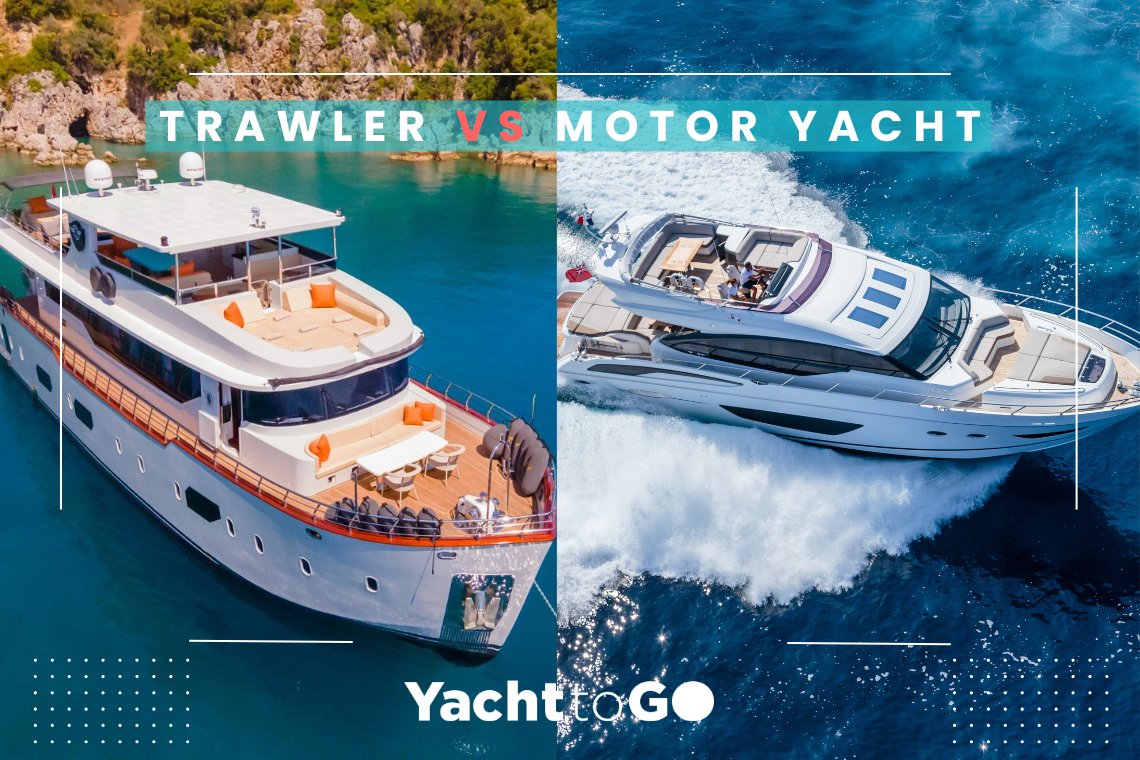
“Captain, I want to go fast, but I refuse to pay $3,000 a day just for diesel.” I hear this every Tuesday. Guests look at a sleek 80-foot boat and imagine flying across the water. Then they look at the Advanced Provisioning Allowance (A.P.A.) estimate for fuel, and their eyes widen. You cannot cheat the ocean. If you want speed, you pay at the pump. If you want range and stability, you trade the top-end speed for a heavy, deep hull. Choosing between a trawler and a standard motor yacht changes your entire holiday. Let me explain how hull shapes, engine blocks, and stabilizers dictate your time on the water.
If you plan to cross the open, windy stretch near Cape Kurdoğlu, a trawler’s heavy displacement hull will save your breakfast. If you just want to zip from Göcek marina to Yassıca Island before sunset, the motor yacht wins.
Water is dense. To move through it, a boat must either push the water out of the way or climb on top of it. This is the fundamental difference between these two vessels. A trawler uses a displacement hull. It sits deep in the water. Its bow is sharp. It cuts cleanly through the waves. It never tries to lift out of the water. Because of this, it requires very little horsepower to maintain a steady 10 knots.
A standard motor yacht uses a planing hull. At low speeds, it pushes water like a trawler, but very inefficiently. When the captain pushes the throttles forward, the twin engines roar. The sheer force lifts the bow high into the air. The boat climbs over its own bow wave and flattens out, riding on top of the water. This allows speeds of 20 to 30 knots. But the energy required to achieve this lift is massive. If you are browsing our motor yacht charter options in our verified global fleet, you must understand this physical reality.

Let us look at the engine room. This is where your budget is spent. A modern trawler often relies on highly efficient, low-RPM engines. Think of a solid Volvo Penta marine engine or a single, heavy-duty commercial block. Cruising at 10 knots, a 70-foot trawler might burn around 40 to 60 liters of diesel per hour. It sips fuel. The cruising range is massive. You can fill the tanks in Marmaris and not think about fuel for two weeks.
Now look at a sleek 70-foot planing yacht. To achieve 22 knots, it needs serious power. It will likely house twin V12 engines, often from manufacturers like MTU. When those turbos spool up and the boat lifts onto a plane, the fuel burn rate skyrockets. At 22 knots, that boat might burn 350 to 450 liters per hour. The math is simple. One hour of running costs roughly ten times more than the trawler. If you want the speed, you buy the diesel. I never judge the choice, but I insist guests know the numbers before they step aboard.
The Aegean Sea does not care about your itinerary. The afternoon Meltemi winds will blow up sharp, steep waves. How the boat handles this chop defines your comfort. A heavy trawler, with its deep draft and low center of gravity, behaves like a pendulum. It tracks straight. The sharp bow slices the waves apart. You feel a steady, predictable motion. Plates stay on the table. You can walk the deck without gripping the handrails.
A planing motor yacht is lighter. Its hull is flatter at the stern to allow it to skim the surface. When you hit a 1.5-meter chop at 20 knots in a planing hull, you feel the impact. The boat slams into the troughs. The vibration shakes the interior bulkheads. You hear the fiberglass flex. A smart captain will throttle back to 10 knots to save the boat and the guests’ stomachs. But remember, a planing hull is highly inefficient at low speeds. It tends to wander and roll more than a trawler when forced to go slow.
The real test of comfort happens at night. You drop the anchor in a cove. A cross-swell rolls in from a passing ferry. The boat begins to rock side to side. This is anchor roll. Because a trawler has a rounder, deeper hull, it can sometimes roll more at anchor than a flat-bottomed motor yacht. However, marine technology has solved this.
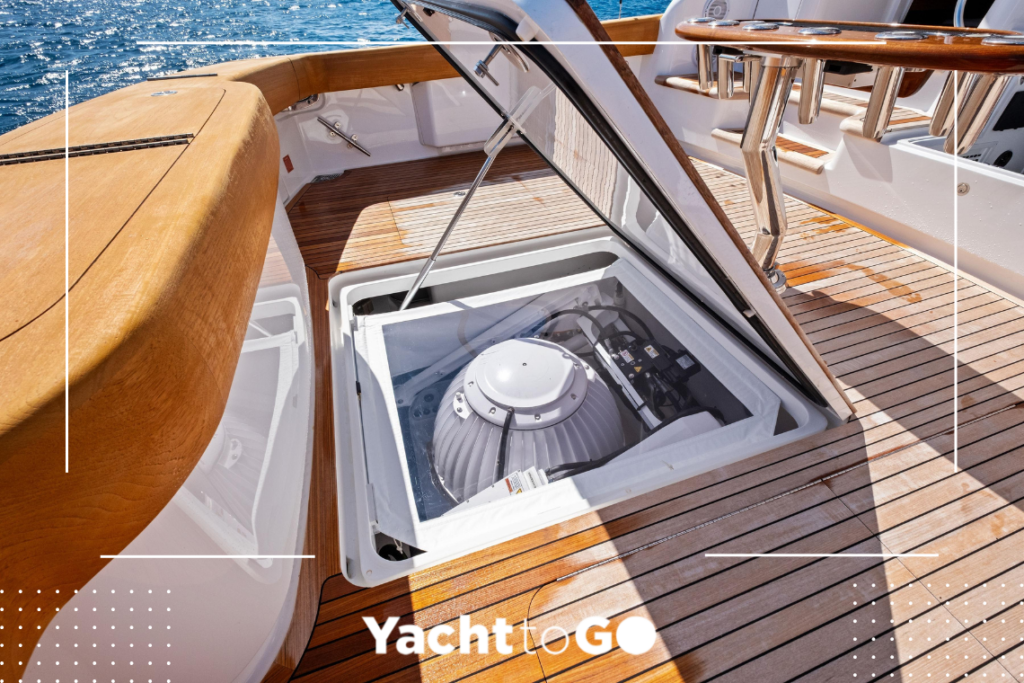
When you check our trawler charter fleet, look for the word “Stabilizers.” Specifically, zero-speed gyroscopic stabilizers, like those made by Seakeeper. These massive spinning spheres sit deep in the hull. They fight the physics of the wave. A stabilized trawler sits completely flat in a rolling anchorage. You sleep soundly. Your coffee stays in the mug. Motor yachts also feature these, but they add weight. If you prioritize comfort over raw speed, insist on a stabilized vessel.
Guest comfort isn’t just about motion. It is about noise. When twin 1,500 horsepower engines fire up beneath the main deck of a fast motor yacht, you feel the hum through the soles of your feet. The exhaust note is loud. Even with excellent sound insulation, you know you are on a fast machine. It feels aggressive. For some, that is the thrill. For others, it is exhausting after four hours.
A trawler engine room is a different environment. The engines run at lower RPMs. The builders use heavy, thick layers of acoustic foam and lead insulation. When a modern trawler cruises at 10 knots, you often only hear the splash of the water against the bow. The steady, low thrum of the single or twin diesels becomes background noise. It is a calmer, quieter way to travel.
The boat must match the map. If you want to explore the Hisarönü Gulf, from Datça down to Bozburun, you are dealing with open stretches of water and strong afternoon winds. The distances between isolated bays are longer. This is trawler territory. You set the autopilot to 10 knots, sit on the flybridge, and let the heavy hull do the work. The extended cruising range means you don’t waste half a day diverting to a fuel dock.
Conversely, look at the Göcek fleet routes. The Bay of Fethiye is packed with islands located just two or three miles apart. The water is generally protected. Here, a fast motor yacht makes sense. You can wake up in one bay, fire up the engines, blast over to a beach club for lunch in 15 minutes, and then race to another cove for dinner. Rapid bay-hopping justifies the planing hull. You spend very little actual time underway, so the high fuel burn rate per hour matters less to your total A.P.A. budget.
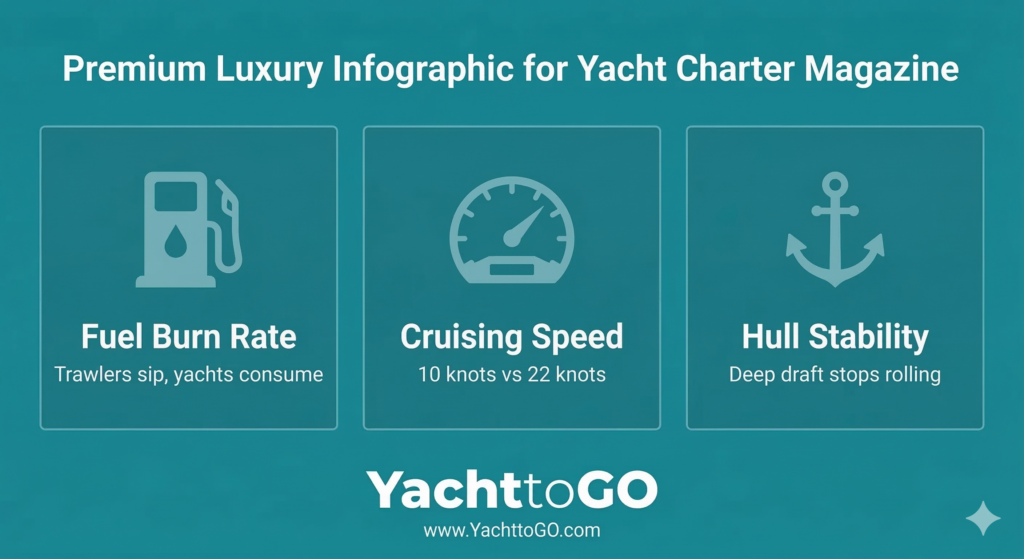
I tell every client the same thing. Do not rent a trawler if you are impatient. Do not rent a planing motor yacht if you hate loud engines and high fuel bills. A trawler is an ocean-going home. It is built for endurance, stability, and volume. A motor yacht is a sports car. It is built for impact, speed, and tight schedules. Review the facts, check your budget for the diesel, and book the boat that matches your reality. The sea does not compromise, and neither should your choice of vessel.
Explore the Luxury of Motor Yacht Charters: Take Your Vacation to the Next Level
| Feature / Option | Key Difference | Comfort Impact | Cost Reality |
|---|---|---|---|
| Cruising Speed | Trawler: 10-12 knots. Motor Yacht: 18-24 knots. | Trawlers offer slow, steady transit. Yachts offer rapid transit. | Time is money. Speed drastically increases A.P.A. fuel costs. |
| Hull Dynamics | Displacement (Cuts water) vs Planing (Rides over water). | Trawlers handle rough chop better. Yachts slam into steep waves. | Planing requires massive horsepower, meaning larger, thirstier engines. |
| Average Fuel Burn | Trawler: 40-70 L/hr. Motor Yacht: 250-450 L/hr. | Lower engine noise on a trawler. High vibration on a fast yacht. | A 4-hour cruise on a yacht costs nearly 10x more in diesel. |
| Volume & Space | Trawlers carry beam far forward. Yachts are sleek and tapered. | Trawlers feel like wide apartments. Yachts feel like luxury jets. | Included in base charter rate, but trawlers offer more space per meter. |
Choose a Yacht to GO where you want! Connect directly with verified yacht owners across our global fleet.
Or let our Master Brokers handle every detail. Finding the perfect match shouldn’t be a burden. Select your preferred level of service below for a seamless, safe, and secure maritime escape.
For fleet availability, standard booking procedures, and general itinerary information.
Yes. Trawlers feature a displacement hull. This means they sit deep in the water and cut through the waves rather than bouncing over them. They offer a much more stable and predictable ride in high winds or choppy conditions, making them ideal for areas with strong crosswinds.
The savings are massive. A fast motor yacht running at 22 knots can easily burn 300 to 400 liters of diesel per hour. A similarly sized trawler running at 10 knots will burn roughly 40 to 60 liters per hour. If you cruise for 3 hours a day over a week, a trawler dramatically lowers your final A.P.A. fuel costs.
Gyroscopic stabilizers, like those made by Seakeeper, are spinning units inside the hull that eliminate side-to-side boat roll. If you are prone to seasickness, or if you simply hate your coffee spilling when another boat drives past your anchorage, you absolutely want a boat equipped with zero-speed stabilizers.
With maritime roots established in 1994, I am a Master Mariner, an elite Yacht Charter Broker, and the Managing Director of YachttoGO and NOMAD Group. Based in Göcek, Fethiye, Turkey, I specialize in curating world-class yacht charters, aviation, and VIP concierge experiences across the Eastern Mediterranean. My vision is to make global yacht chartering seamless and accessible, elevating YachttoGO into the world's top 10 maritime marketplaces. Whether you seek a VIP motor yacht or a classic gulet, my team and I are dedicated to designing your ultimate maritime escape.
Huseyin Uçkun · Meltemi Wind Turkey: A Captain’s Guide to Safe Summer Sailing | YachttoGO Captain’s Log: What You Need to... Read More

Captain’s Log: What You Need to Know About Yacht Charter Provisioning 1. The 21-Day Rule: Your preference sheet must be locked in... Read More
Captain’s Log: What You Need to Know About Yacht Charter Insurance 1. The Money Trap: APA pays for your fuel and food.... Read More
Join The Discussion